Call UsCall Us : 08071930855
Change Language
Fuel Cell Stack 3
Fuel Cell Stack 3

Fuel Cell Stack 3

Fuel Cell Stack 3 Specification

  • Strength
  • High mechanical integrity for lab applications
  • Hardness
  • Not Applicable (Polymer Electrolyte based)
  • Purity
  • 99.99% (Platinum catalyst loading)
  • Product Type
  • Fuel Cell Stack
  • Material
  • Polymer Electrolyte Membrane, Graphite, Platinum
  • Alloy
  • No alloy non-metallic and noble metals only
  • Shape
  • Rectangular stack
  • Moisture
  • Low moisture operation
  • Chemical Composition
  • Proton Exchange Membrane (PFSA), Carbon Paper, Platinum catalyst
  • Application
  • Research, Laboratory, Educational Demonstrations
  • Dimension (L*W*H)
  • 100 mm x 50 mm x 50 mm (approximate)
  • Color
  • Silver/Gray
  • Current Output
  • Maximum 2 Amps
  • Gas Connector Type
  • Barbed fittings (for 3 mm tubes)
  • Stack Assembly Type
  • Bolt-Clamped Modular Plates
  • Weight
  • Approx. 250 grams
  • Fuel Supply
  • Hydrogen (H2), Ambient Air/Oxygen (O2)
  • Sealing
  • PTFE or Silicone O-rings/Gaskets
  • Nominal Voltage
  • 2.1 V to 2.4 V (0.7-0.8V per cell)
  • Rated Power Output
  • Up to 5 Watts
  • Operating Temperature
  • 20°C to 60°C
  • Number of Cells
  • 3 cells in stack (series connected)
  • Efficiency
  • 35% - 50% (System dependent)
  • Humidification Requirement
  • External humidification required for optimum performance
 

Fuel Cell Stack 3 Trade Information

  • Payment Terms
  • Paypal
  • Delivery Time
  • 15 Days
  • Main Export Market(s)
  • North America, Eastern Europe, Central America, South America, Asia
  • Main Domestic Market
  • All India
 

About Fuel Cell Stack 3

Fuel CellStack 3

Brand: H-TEC Education
Product Code: 1071038

Description:

H-TEC's Fuel Cell Stack 3 is a modular fuel cell stackwith 3 cells that are easy to add or remove.  The Fuel Cell Stack 3 allowsvoltages between individual cells to be measured.  The stack is deliveredfully assembled.


About the PEM Fuel Cell Process

Hydrogen gas is oxidized within a fuel cell.  In theprocess, the chemical energy stored in the hydrogen gas is converted directly,i.e. without combustion, to electrical energy.  This process takes placein the heart of the fuel cell, the Membrane Electrode Assembly (MEA).

The MEA comprises two electrodes (cathode: oxygen sideand anode: hydrogen side) and the Proton Exchange Membrane (PEM).  The PEMis a special plastic film which is permeable to protons but which presents abarrier to electrons.

Hydrogen gas is split by catalysis into electrons andprotons in the fuel cell.  Due to the chemical imbalance created, theprotons (cations) diffuse through the PEM.  The resulting potentialdifference can be tapped on the electrodes in the form of a no-load voltage. As soon as an electric circuit is connected to the fuel cell, the surpluselectrodes flow to the cathode, where they combine with the oxygen and theprotons to form water (H2O).  The water produced escapes viathe air vent in the form of water vapor.


Fuel Cell Stack 3 Features:
 
Modular design
 Flexible power output
 Single gas supply for whole stack
 Easy to add or remove cells from fuelcell stacks

Technical Specifications:

 Power Per Cell: 200 mW
 Total Power (3 Cells): 600 mW
 Generated Voltage: 0.4 - 0.96 V per cell
 Electrode Area: 4cm² per cell
 Dimensions (H x W x D): 2.4" x3.7" x 2.8" (60 x 95 x 70 mm)
 Weight: 7.4 oz (211 g)
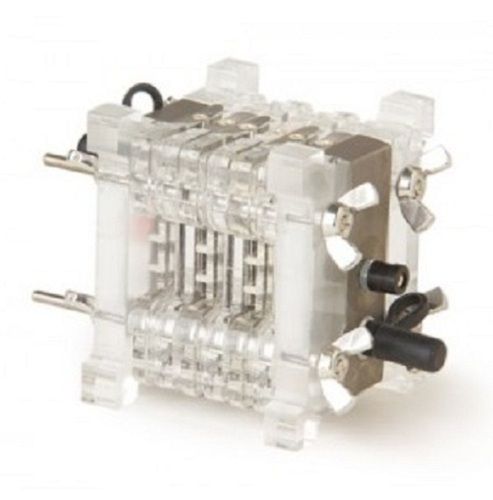


High-Efficiency Fuel Cell Stack for Research Laboratories

Engineered for academic and laboratory environments, the Fuel Cell Stack 3 delivers stable, reliable power with hydrogen fuel and ambient air or oxygen. Its modular, bolt-clamped design provides ease of assembly and service. The stacks use of a polymer electrolyte membrane and platinum catalyst ensures purity, resilience, and consistent output, meeting the demands of research and demonstration setups. Lightweight and compact, it is favored by laboratories, educators, and distributors alike.


Optimized for Educational Demonstrations

This fuel cell stacks robust structure and low maintenance requirements make it an excellent choice for hands-on learning, experiments, and presentations. Designed for safe operation with high-purity hydrogen and ambient air, it provides students and researchers with a clear, real-world illustration of proton exchange membrane (PEM) technology, while requiring external humidification for peak efficiency.

FAQs of Fuel Cell Stack 3:


Q: How do I operate the Fuel Cell Stack 3 safely in a laboratory setting?

A: Ensure hydrogen (H2) and ambient air (O2) are supplied at appropriate flow rates and concentrations. Use 3 mm barbed fittings for gas connections, verify seals with PTFE or silicone O-rings, and maintain the stack within a 20C to 60C operating range. Adequate external humidification should be provided to maintain optimal cell performance.

Q: What applications is the Fuel Cell Stack 3 best suited for?

A: This stack is specifically engineered for research, laboratory experiments, and educational demonstrations. It is ideal for universities, research institutions, and demonstration setups thanks to its robust mechanical integrity, moderate power output, and straightforward integration.

Q: When is external humidification required, and why is it important?

A: External humidification should always be used when operating this stack to prevent membrane dehydration, which can reduce efficiency and performance. Controlled humidity ensures consistent electrochemical reactions within the stack, promoting longevity and reliable output.

Q: Where can I purchase or source the Fuel Cell Stack 3 in the United States?

A: The Fuel Cell Stack 3 is available through authorized distributors, manufacturers, suppliers, retailers, and traders throughout the United States. Reach out to these channels for product availability, technical support, and purchasing information.

Q: What is the process for connecting and supplying gas to the fuel cell stack?

A: Connect hydrogen and ambient air/oxygen sources using the built-in barbed fittings for 3 mm tubing. Ensure all connections are securely clamped and sealed with PTFE or silicone O-rings/gaskets. Always use hydrogen of at least 99.99% purity for optimal performance.

Q: How does the Fuel Cell Stack 3 benefit research and educational environments?

A: Its compact form, bolt-clamped modularity, and high-purity construction facilitate clear demonstration of PEM fuel cell principles and hands-on experimentation, making it a valuable tool for evolving research and engaging classroom instruction.

Tell us about your requirement
product

Price:

Quantity
Select Unit

  • 50
  • 100
  • 200
  • 250
  • 500
  • 1000+
Additional detail
Mobile number

Email

More Products in Fuel Cell Stacks Category

Double Reversible Fuel Cell H2/O2/Air

Double Reversible Fuel Cell H2/O2/Air

Dimension (L*W*H) : Approx. 12.5 x 9 x 2.5 cm

Color : Transparent/clear with metallic contact plates

Chemical Composition : PEM (Polymer Electrolyte Membrane), Platinum Catalyst, Stainless Steel Frame

Product Type : Other, Double Reversible Fuel Cell H2/O2/Air

Purity : 99.99% (Hydrogen/Oxygen compatibility)

Material : Polycarbonate body, platinum coated electrodes, silicone gaskets

Syringe (Without Needle)

Syringe (Without Needle)

Dimension (L*W*H) : Varies, common sizes 2ml, 5ml, 10ml, 20ml (specify as per requirement)

Color : Transparent barrel with black measurement markings

Chemical Composition : Medical grade polypropylene (barrel and plunger), rubber or synthetic gasket

Product Type : Other, Medical syringe without needle

Purity : Sterile, nontoxic, pyrogenfree

Material : Polypropylene (PP), synthetic rubber gasket

Flex-Stak Expansion Kit

Flex-Stak Expansion Kit

Dimension (L*W*H) : Customized / Modular

Color : Black

Chemical Composition : Highgrade industrial polymers

Product Type : Other, Expansion Kit for Flexible Storage

Purity : High

Material : Industrial polypropylene plastic

300W Liquid Cooled PEM Fuel Cell Stack

300W Liquid Cooled PEM Fuel Cell Stack

Dimension (L*W*H) : Approx. 210mm x 160mm x 120mm

Color : Silver and black (as pictured)

Chemical Composition : Membrane: Nafion; Plates: Graphite or Metal; Catalyst: Ptbased

Product Type : Other, Proton Exchange Membrane (PEM) Fuel Cell Stack

Purity : High purity hydrogen required (>99.99%)

Material : Polymer Electrolyte Membrane, Graphite or Metal Bipolar Plates, Platinum Catalyst