Surface Plasmon Resonance (SPR) Sensor Chips About
Surface Plasmon Resonance (SPR) Sensor Chip
Platypus Technologies and GWC have partnered to deliverhigh quality sensor chips for Surface Plasmon Resonance (SPR).
SPRchipTM
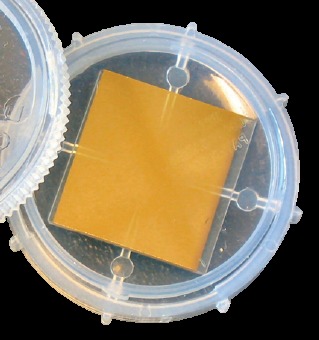
Surface Plasmon Resonance (SPR) enablesresearchers to investigate molecular and cellular interactions. PlatypusTechnologies SPRchipTM provides a pristine goldsurface to give you complete control over surface attachment strategies for SPRanalysis. The SPRchipTM is dextran-free, ready for youto apply any surface chemistry you prefer.
The SPRchipTM sensor chip wasdesigned for the SPRimagerII and Horizon imaging system from GWC Technologies,but it can be used with a variety of instruments for SPR,ellipsometry, PM-IRRAS, QCM or XPS.
Chip dimensions: 1 mm x 18mm x 18 mm
Refractive index of glass: 1.72
SPOTREADYTM
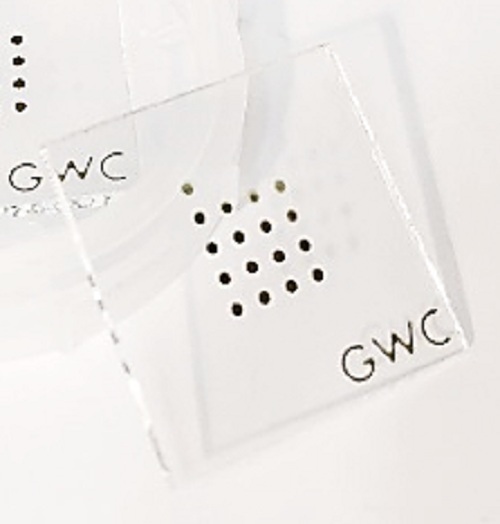
SpotReadyTM chip has gold spots arranged in a grid pattern,and each spot is surrounded by a hydrophobic background layer to allow easyhand-spotting of probes onto the individual spots. The hydrophobicsurround prevents aqueous probe solution from flowing over the edge of the goldspot.
The SpotReadyTM sensor chipwas designed for the SPRimagerII and Horizon imaging systems from GWCTechnologies, but it can be used with a variety of instruments forSPR, ellipsometry, PM-IRRAS, QCM or XPS.
Chip dimensions: 1 mm x 18mm x 18 mm
Refractive index of glass: 1.72

Optical Performance & CompatibilitySPR Sensor Chips are optimized for wavelengths between 600800 nm, providing reliable compatibility with many biosensing instruments. The high-purity gold coating guarantees minimal autofluorescence and superior signal-to-noise ratios, enabling accurate chemical and biomolecular analyses.
Surface Quality and ReliabilityUtilizing high-quality BK7 optical glass and a uniform gold layer, these chips maintain a surface roughness less than 1 nm RMS. Nanometer-grade cleanliness and chamfered edges enhance both reliability and user safety, supporting sensitive applications across research and industry.
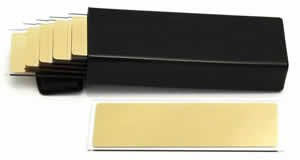
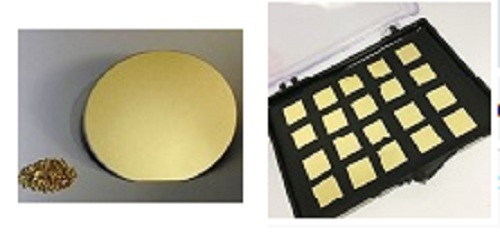
Flexible Packaging & StorageCustomizable pack sizes (10/20/50 chips) cater to diverse laboratory demands. Store chips in a dry, dust-free environment at room temperature to preserve the ultra-clean gold surface and maintain optimal SPR performance throughout storage and use.
FAQs of Surface Plasmon Resonance (SPR) Sensor Chips:
Q: How is the surface coating thickness on SPR sensor chips controlled and customized?
A: The gold thin film coating is typically around 50 nm but can be tailored during manufacturing to suit specific research requirements. This ensures optimal surface plasmon resonance sensitivity for various biomolecular and chemical sensing applications.
Q: What cleaning protocols are recommended for reusing SPR sensor chips?
A: SPR sensor chips can be reused if cleaned gently with appropriate solvents and procedures that do not compromise the gold surface integrity. Specific cleaning guidelines should be followed to avoid contaminating or damaging the nanometer-grade clean surface.
Q: When should SPR sensor chips be stored, and what conditions are ideal?
A: Store chips immediately after use in a dry, dust-free environment at room temperature. Proper storage protects the ultra-clean gold surface and maintains chip performance for future biosensing or analytical experiments.
Q: Where can these SPR sensor chips be applied?
A: These chips are widely employed in biosensing, chemical sensing, and biomolecular interaction analysis. They are suitable for research labs, diagnostic platforms, and industrial settings throughout the United States and globally.
Q: What is the benefit of using high-purity (99.999%) gold thin films on SPR chips?
A: A high-purity gold layer ensures consistent plasmonic response, reduces background noise from impurities, and maximizes sensitivity and reliability in quantitative analyses of biological and chemical samples.
Q: How does the polished and chamfered edge treatment affect usage?
A: Polished and chamfered edges improve safety during handling and prevent chipping, making them ideal for high-throughput laboratories and repeated use in rigorous experimental setups.
Q: What ensures the optical quality and low autofluorescence of these SPR sensor chips?
A: The use of BK7 optical glass and nanometer-scale ultra-clean gold coating provides exceptional optical clarity and negligible background fluorescence, critical for detecting subtle biomolecular interactions with high precision.
 Call Us : 08071781050









 Send Inquiry

 Send Inquiry
 Send Inquiry
 Send SMS